Launch offer — valid today only

📄 Digital book in PDF · read it on your phone or print it

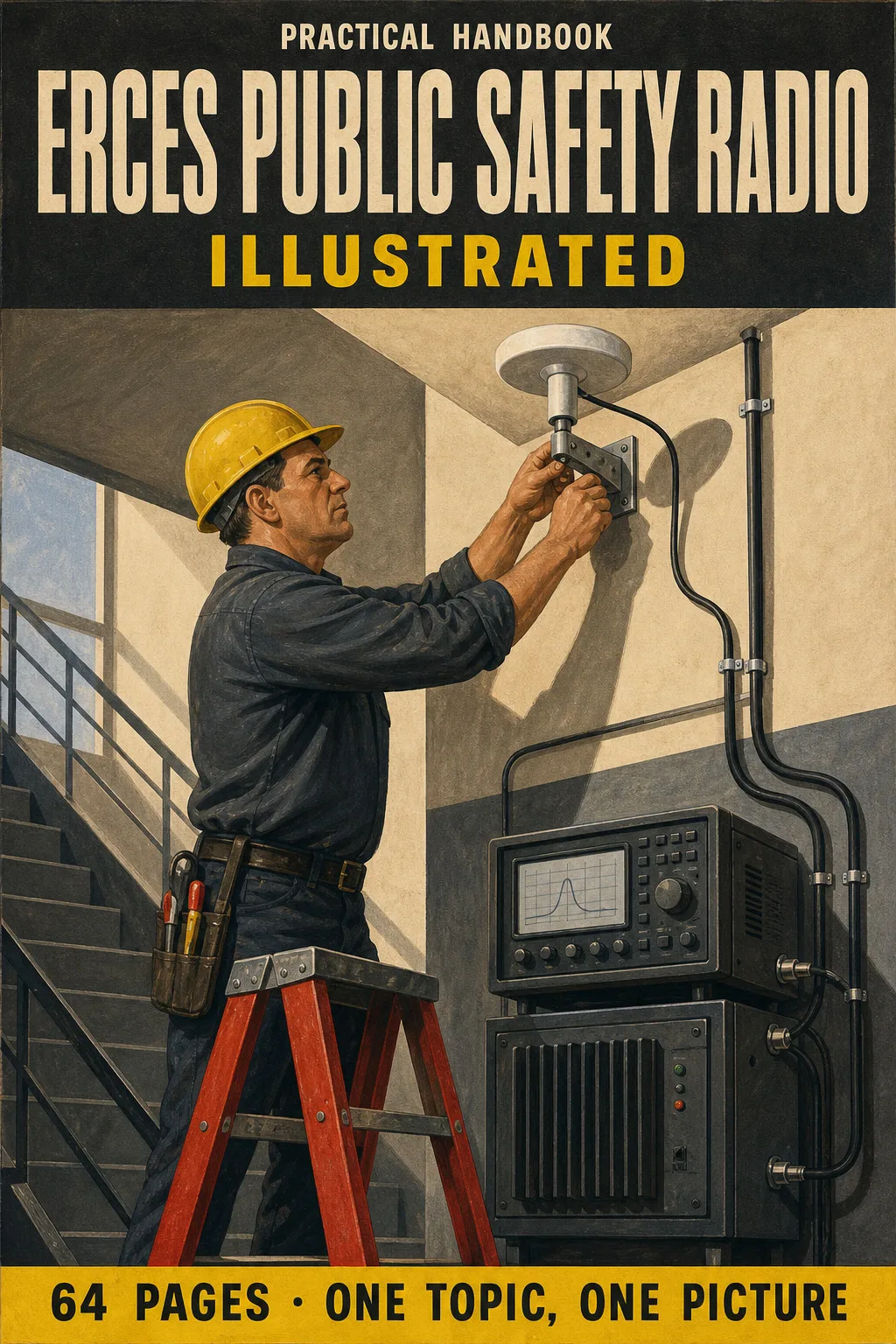
ERCES and NICET IB-PSC Level I in Drawings: Work the Link Budget in 4 Steps, from the Roof to the Stairwell One Topic on Every Page

Donor antenna, BDA, coax and splitters, dB and dBm, the link budget, backup power, supervision, the coverage grid and the acceptance test. Each topic gets its own page: the drawing first, then what you need to remember. 64 illustrated pages.

START STUDYING THIS WAY

🔒 Secure checkout · PDF by email · 30-day guarantee

Every topic, its own pageThe signal path drawn, with the explanation right beside it
64 illustrated pages8 parts, from why radios die inside buildings to the walk-test review
Up-to-date sourcesIFC 510, NFPA 1225 and NFPA 72
PDF by emailFormat

Look Inside the Book

Every page has one big drawing and a box with the numbers and rules you need to know:

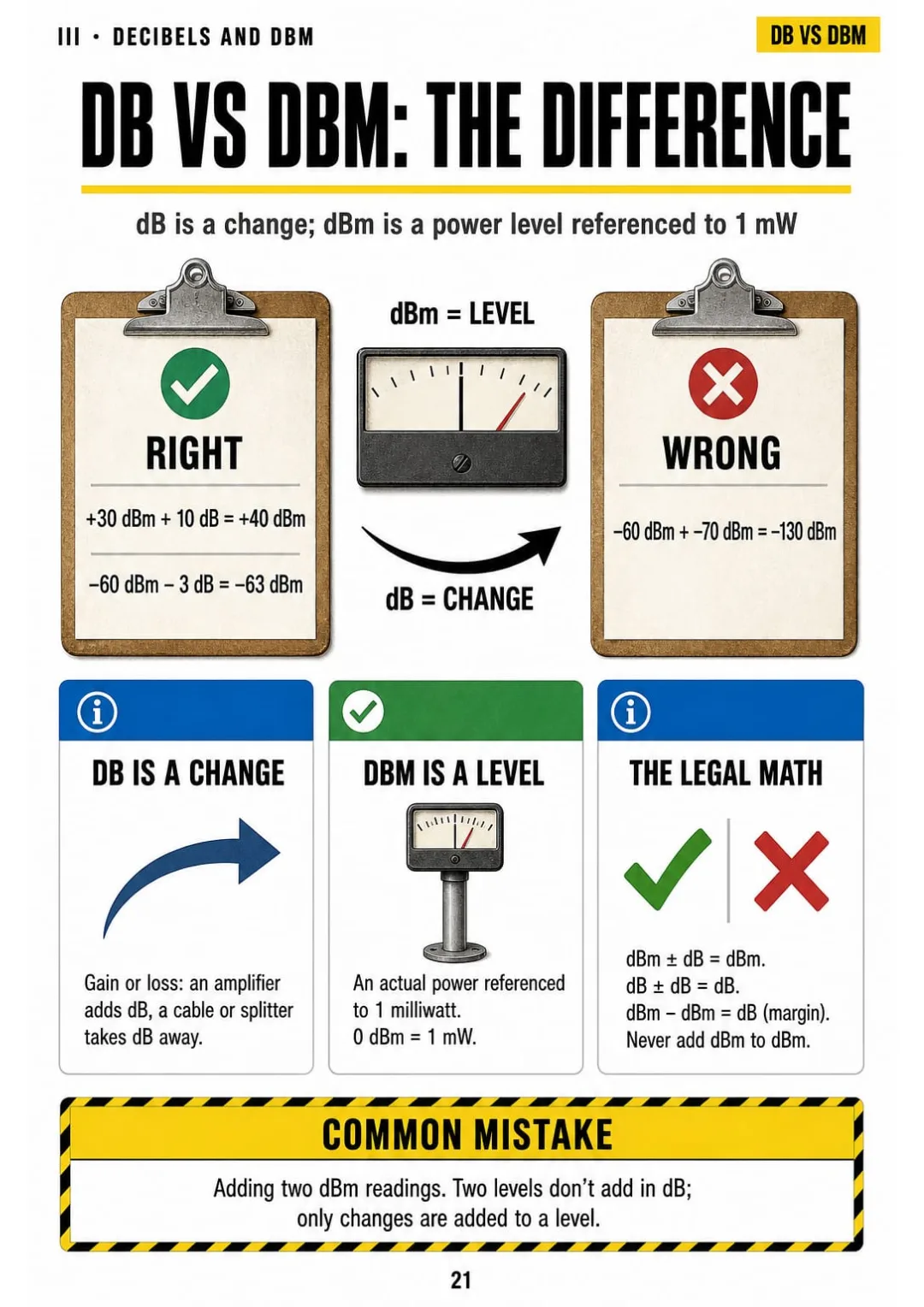
dB is a gain or loss; dBm is a power level referenced to 1 milliwatt.
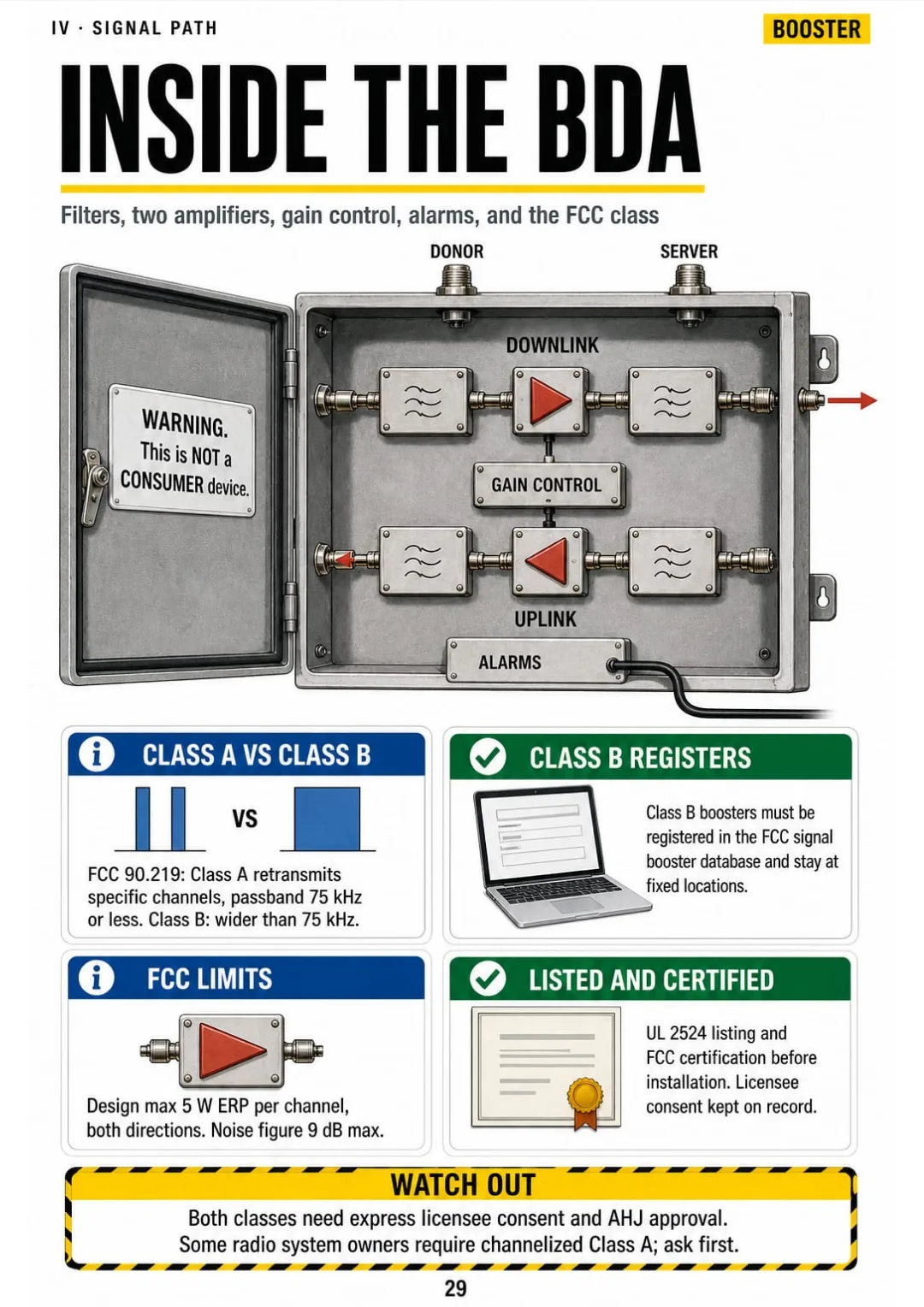
BDA: Class A up to 75 kHz, Class B wider and registered; 5 W ERP per channel max.
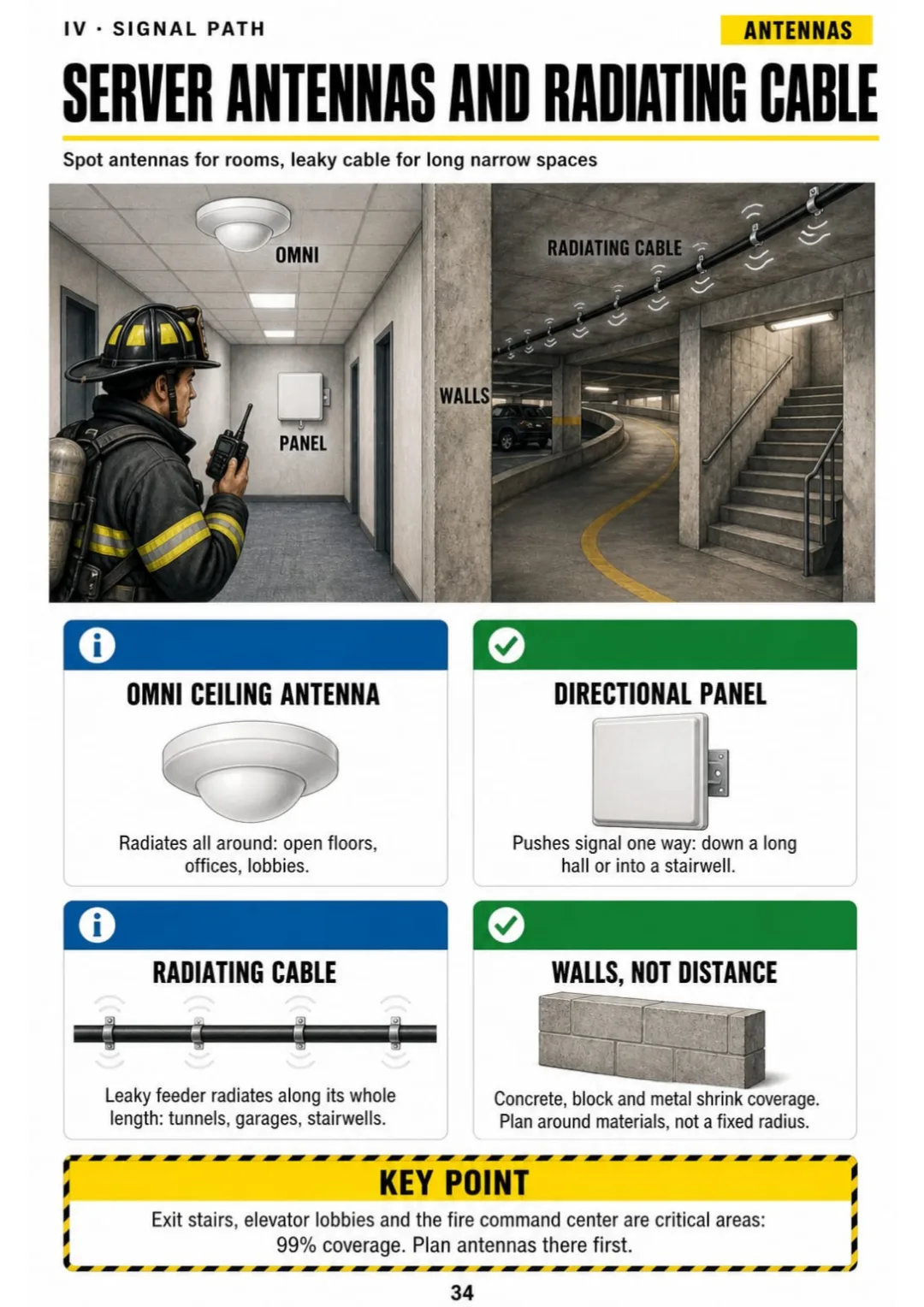
Omni, panel or radiating cable: choose by the space and its walls.
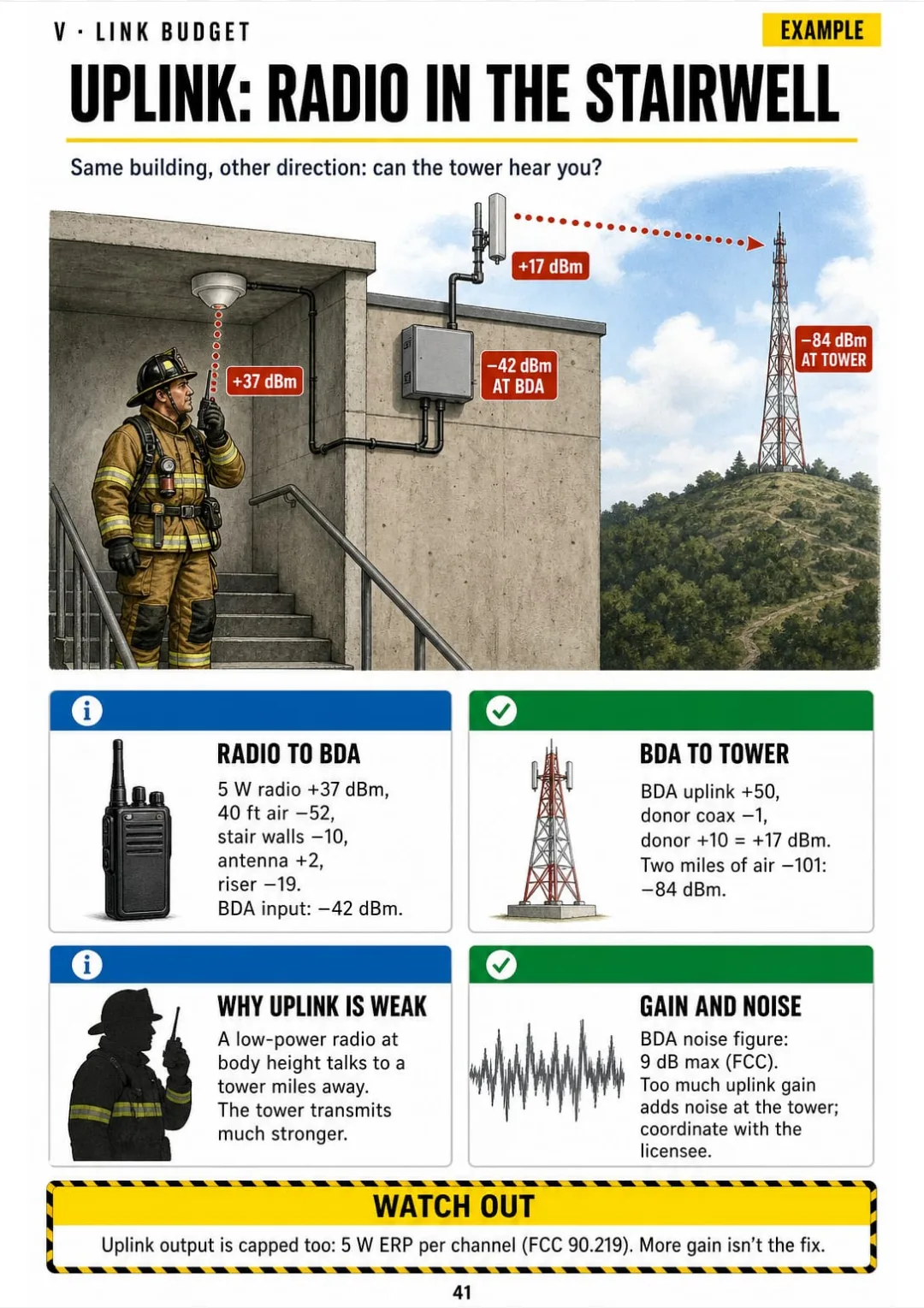
5 W radio in the basement stair → −84 dBm at the tower: +11 dB vs −95
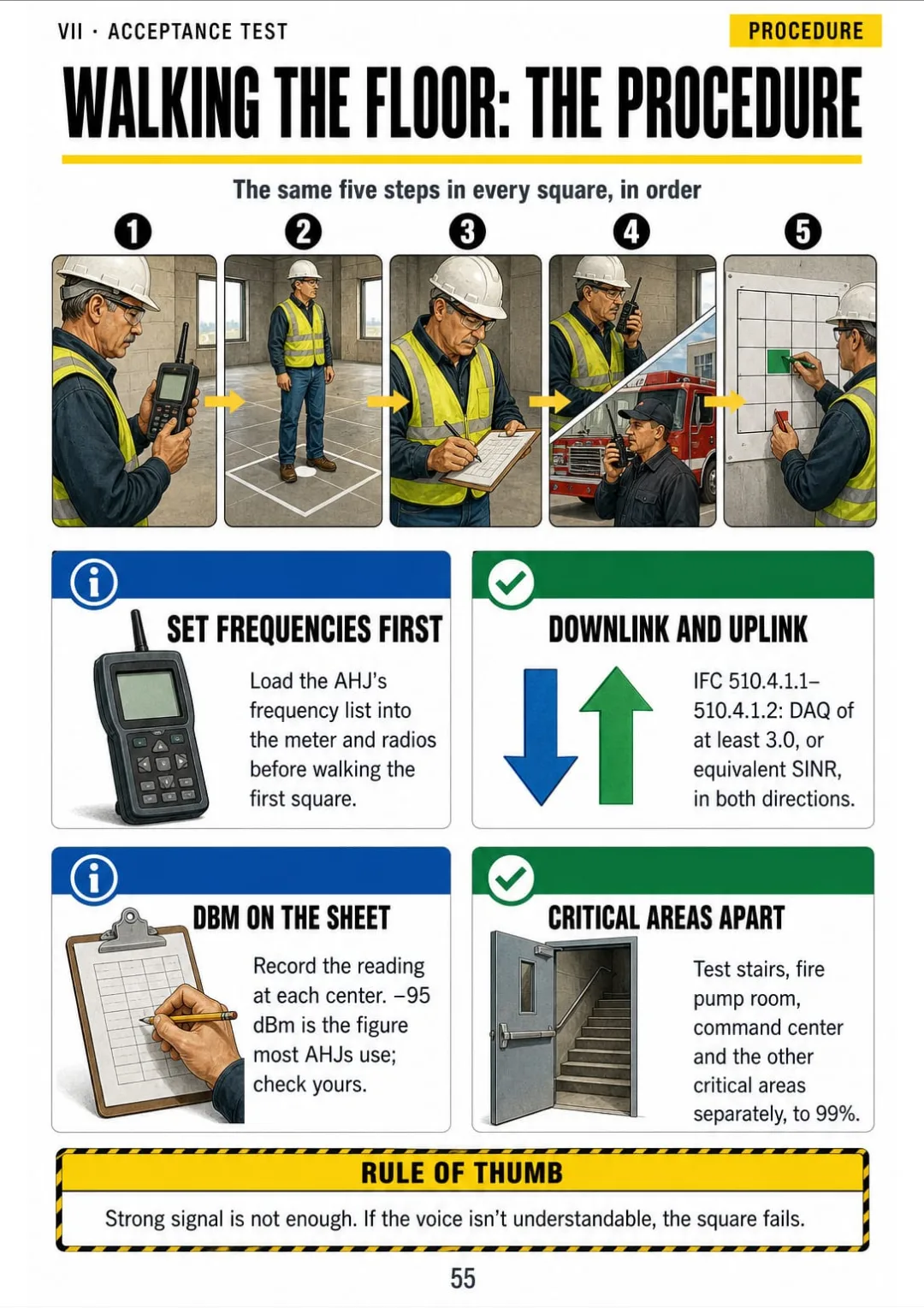
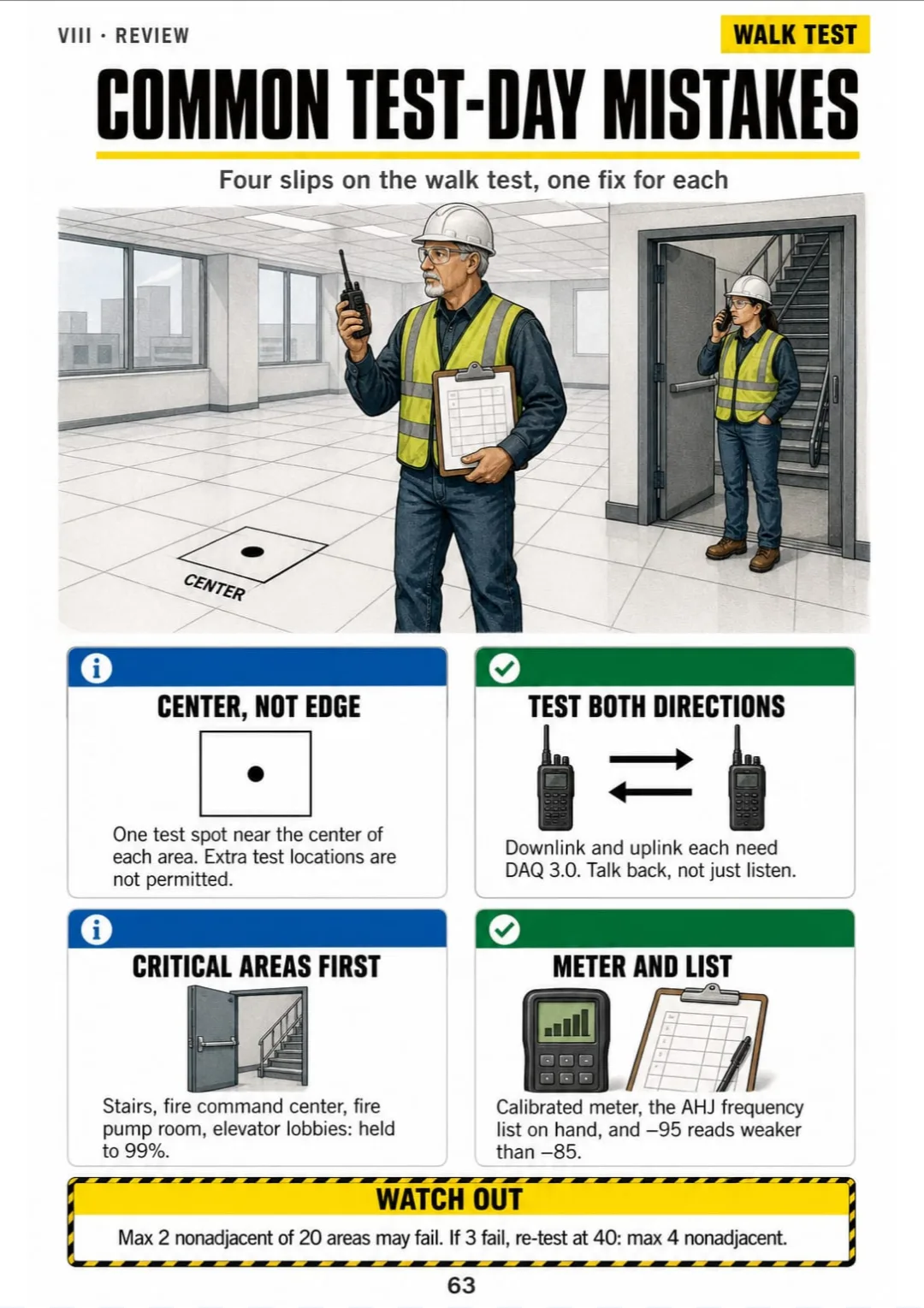
Each square: set frequencies, stand at center, record dBm, talk-back DAQ ≥ 3.0, mark pass/fail
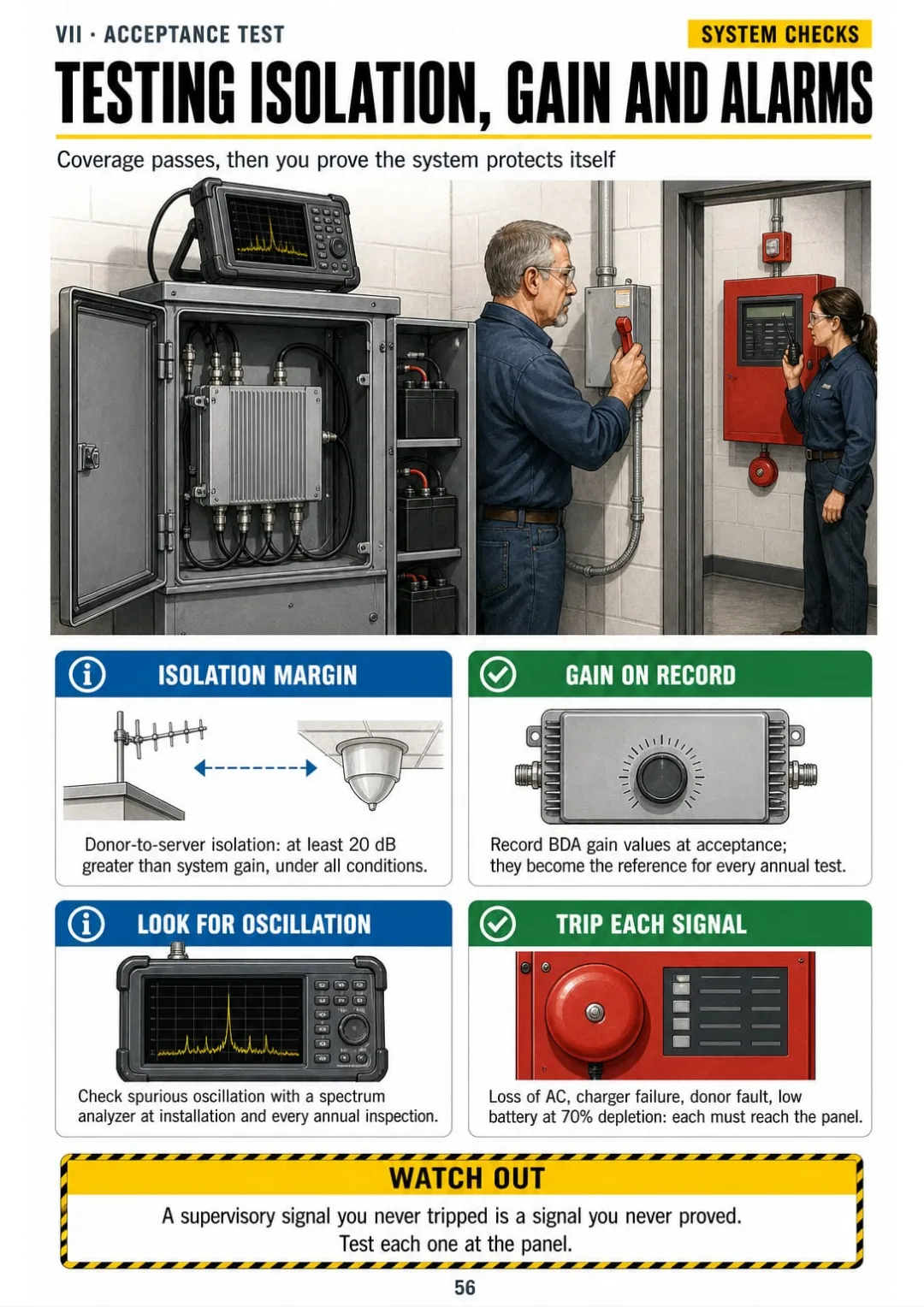
Isolation ≥ 20 dB over system gain, gain on record, every supervisory signal tripped
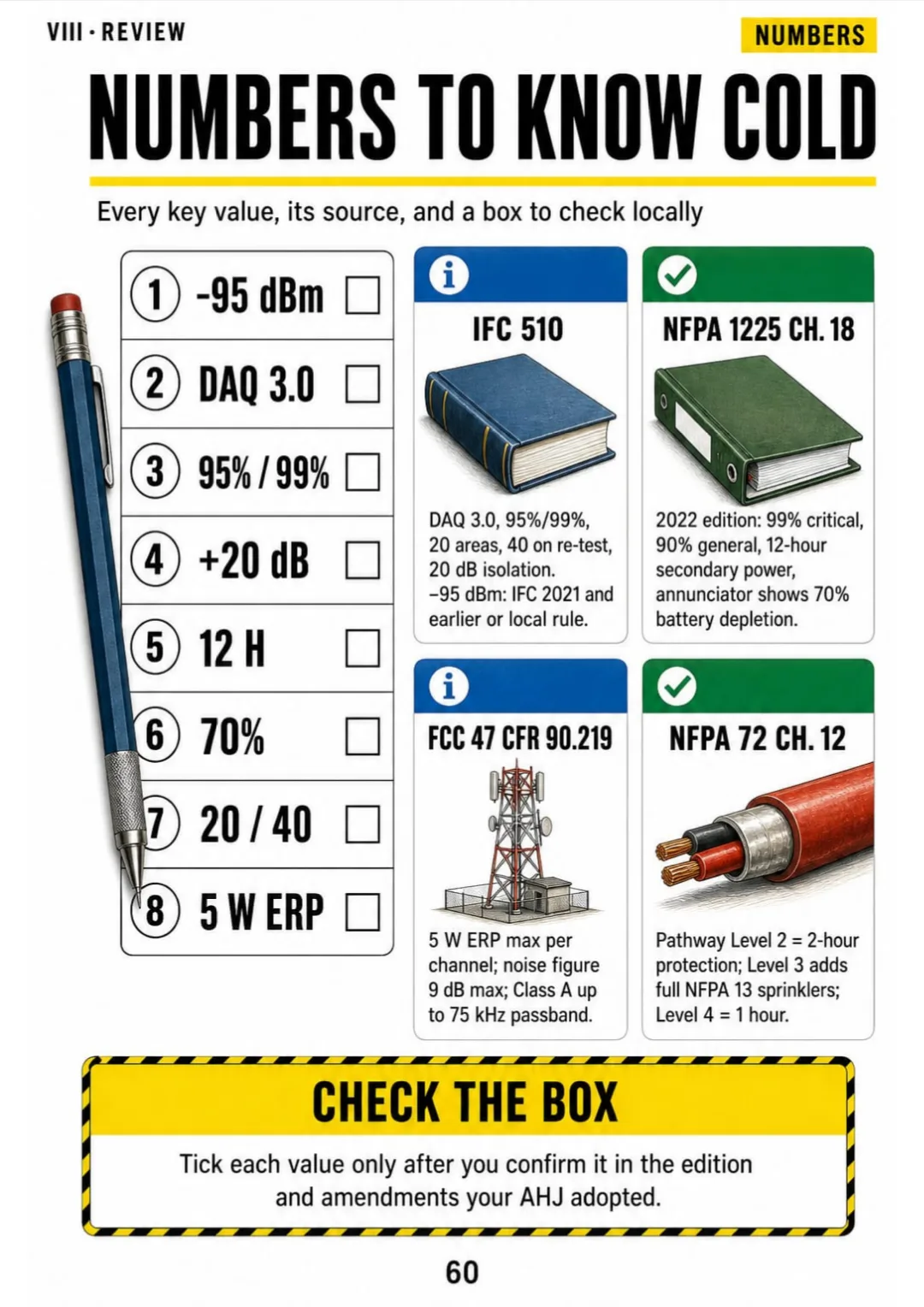
−95 dBm, DAQ 3.0, 95/99%, 20 dB, 12 h, 70%, 20/40 areas, 5 W ERP
Center of each square, uplink and downlink, critical areas at 99%

Swipe to see more →

These are real pages from the book. The table of contents is the full one: 8 parts and 60 topics.

The Problem Isn't You. It's How It Was Taught.

You're standing in a parking garage with a reel of radiating cable and a box of omni antennas. Concrete columns everywhere, a ramp down to P3, and the plans just say "provide coverage."

The manual gives you pages of antenna patterns and leaky feeder in long paragraphs. Nothing tells you which one goes where, so you guess and hope the walk test agrees.

Omni, panel or radiating cable: choose by the space and its walls.

In this book it's one page: the omni antenna on the ceiling of an open floor, the panel antenna aimed down a long corridor, the radiating cable run through a tunnel or a stairwell. You choose by the space and its walls.

Same with the donor antenna, the BDA, splitters and couplers, the link budget and the coverage grid: each one has its own page.

You look at the space, you know what goes there, and you lay it out without going back to the manual.

COMPARE FOR YOURSELF

The Same Topic, Two Ways to Study It

THIS
  • The manual: line after line of text
  • BDA classes explained with words only
  • You walk into the exam still unsure
A bi-directional amplifier (BDA) is a signal booster that receives, amplifies and retransmits RF energy in both the downlink and uplink directions. Under 47 CFR 90.219, signal boosters are categorized as Class A, whose passband does not exceed 75 kHz and which amplifies only discrete channels, or Class B, whose passband exceeds 75 kHz and which must be registered prior to operation. Effective radiated power shall not exceed 5 watts per channel, and licensee consent must be obtained before any booster is placed into service.
FOR THIS
  • The BDA drawn, inside and out
  • The limits in one box: 75 kHz, 5 W ERP
  • You see it and you get it
BDA: Class A up to 75 kHz, Class B wider and registered; 5 W ERP per channel max.
CONTENTS

Take a Look at the 8 Parts and 60 Topics

What ERCES is and who rules it, radio basics, decibels and dBm, the signal path, the link budget in 4 steps, power and supervision, coverage and the acceptance test, and the final review: 64 pages, all illustrated.

IWhat ERCES Is and Who Rules It · pp. 5-11
  1. Why Firefighters' Radios Die Inside Buildings
  2. The Whole System in One Drawing
  3. Which Code Applies: IFC 510, NFPA 1225, NFPA 72
  4. The AHJ and Local Amendments
  5. When a Building Needs an ERCES
  6. FCC Rules: Licensee Consent and Booster Registration
  7. Who Can Install and Test
IIRadio Basics for the Trade · pp. 12-18
  1. Frequency and Wavelength Without the Formulas
  2. Downlink and Uplink: Two Directions, Two Problems
  3. Simplex, Duplex and Trunked Systems
  4. Channels, Bandwidth and the Frequency List
  5. What Blocks the Signal: Building Materials
  6. Noise, Interference and the Noise Floor
  7. DAQ: Is the Voice Understandable?
IIIDecibels and dBm Made Routine · pp. 19-26
  1. Why We Use dB Instead of Watts
  2. The Two Rules: 3 dB and 10 dB
  3. dB vs dBm: The Difference That Trips People Up
  4. The dBm Ladder
  5. Why −95 Is Weaker Than −85
  6. Gain: Antennas and Amplifiers
  7. Loss: Cable, Connectors, Splitters
  8. Mental Math Drills for the Exam
IVThe Signal Path, Piece by Piece · pp. 27-35
  1. The Donor Antenna
  2. Lightning and Grounding at the Roof
  3. The BDA (Signal Booster)
  4. Gain Settings and Automatic Gain Control
  5. Isolation: Keeping the Booster From Feeding Itself
  6. Coax Cable: Sizes and Ratings
  7. Splitters, Couplers and Tappers
  8. Server Antennas and Radiating Cable
  9. Fiber DAS: When Coax Isn't Enough
VThe Link Budget in 4 Steps · pp. 36-42
  1. The 4-Step Method
  2. Step 1: The Starting Power
  3. Steps 2 and 3: Gains Up, Losses Down
  4. Step 4: Compare and Find the Margin
  5. Worked Downlink Example: 10-Story Office
  6. Worked Uplink Example: The Radio in the Stairwell
  7. Free-Space Path Loss Without Fear
VIPower, Pathways and Supervision · pp. 43-50
  1. Primary Power: Dedicated Branch Circuit
  2. Secondary Power: The 12-Hour Battery
  3. NEMA 4 Enclosures
  4. Pathway Survivability: The 2-Hour Rule
  5. What Must Be Supervised
  6. Tying Into the Fire Alarm Panel
  7. The Dedicated Annunciator
  8. Labels, Signs and the Documents Box
VIICoverage and the Acceptance Test · pp. 51-58
  1. General Areas vs Critical Areas
  2. The Grid: 20 Areas per Floor
  3. How Many Squares Can Fail
  4. The Instruments You Use
  5. Walking the Floor: The Test Procedure
  6. Testing Isolation, Gain and Alarms
  7. The Acceptance Test Report
  8. Annual and Ongoing Testing
VIIIReview for the Exam and the Walk Test · pp. 59-64
  1. The Master Diagram, Fully Labeled
  2. Numbers to Know Cold
  3. dB Math Cheat Sheet
  4. Common Install Mistakes
  5. Common Test-Day Mistakes
  6. Before the Exam, Before the Inspector

One Page, One Topic, All Clear

Think of it this way:

The inspector hands you the radio on the ninth floor and asks why the stairwell reads −98 dBm. You need the link budget, right there.

In the book you open the link budget page and see the whole run drawn: the starting power at the roof, the gains going up, the losses going down, and the margin in a box at the end.

Each square: set frequencies, stand at center, record dBm, talk-back DAQ ≥ 3.0, mark pass/fail

Same with dB vs dBm, the BDA, splitters and couplers, the coverage grid and the walk-test procedure: each one on its own page.

ERCES Public Safety Radio Illustrated is 8 parts and 60 topics, all drawn, with a final review: the master diagram, the numbers to know cold and a dB cheat sheet.

What you see drawn, you don't have to memorize.

What's Inside ERCES Public Safety Radio Illustrated:

Ipp. 5-11

What ERCES Is and Who Rules It

Why radios die inside buildings, the whole system in one drawing, IFC 510, NFPA 1225 and NFPA 72, the AHJ, FCC consent and registration, and who can install and test.

IIpp. 12-18

Radio Basics for the Trade

Frequency without formulas, downlink and uplink, simplex, duplex and trunked, channels, building materials, the noise floor and DAQ.

IIIpp. 19-26

Decibels and dBm Made Routine

You stop fighting logarithms: the 3 dB and 10 dB rules, dB vs dBm, the dBm ladder and why −95 is weaker than −85, with mental math drills you can do on a job site.

IVpp. 27-35

The Signal Path, Piece by Piece

Donor antenna, roof grounding, the BDA, gain and AGC, isolation, coax, splitters and couplers, server antennas, radiating cable and fiber DAS.

Vpp. 36-42

The Link Budget in 4 Steps

You work any link budget the same way every time: starting power, gains up, losses down, the margin. Worked through a 10-story downlink, a stairwell uplink and free-space path loss.

VIpp. 43-50

Power, Pathways and Supervision

Dedicated branch circuit, the 12-hour battery, NEMA 4 enclosures, 2-hour pathway survivability, supervision, the fire alarm tie-in, the annunciator and labels.

VIIpp. 51-58

Coverage and the Acceptance Test

You walk the acceptance test knowing the rules: general vs critical areas, the 20-area grid and how many squares can fail, the instruments, the walk procedure, isolation and alarm tests, the report and annual testing.

VIIIpp. 59-64

Review for the Exam and the Walk Test

The master diagram fully labeled, the numbers to know cold, a dB cheat sheet, common install and test-day mistakes, and a last check before the exam.

At the end of the book: The master diagram fully labeled, the numbers to know cold and a dB math cheat sheet.
Plus: 2 Free Books

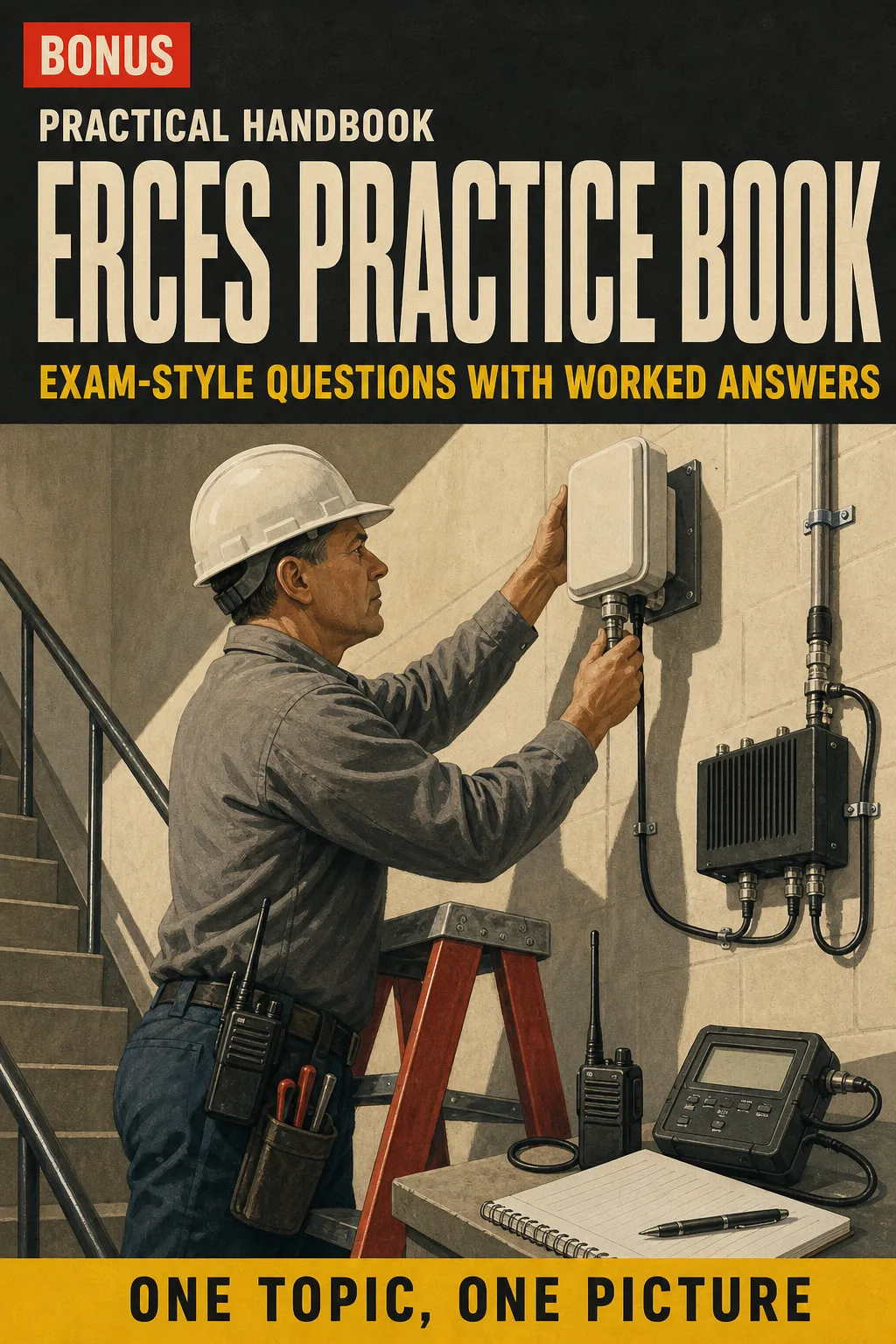
ERCES Practice Book: Exam-Style Questions with Worked Answers

BONUS 1: «ERCES Practice Book: Exam-Style Questions with Worked Answers»

Value on its own: US$ 17.90

Practice the topics you just read with exam-style questions, and see every answer explained in a drawing, dB math included.

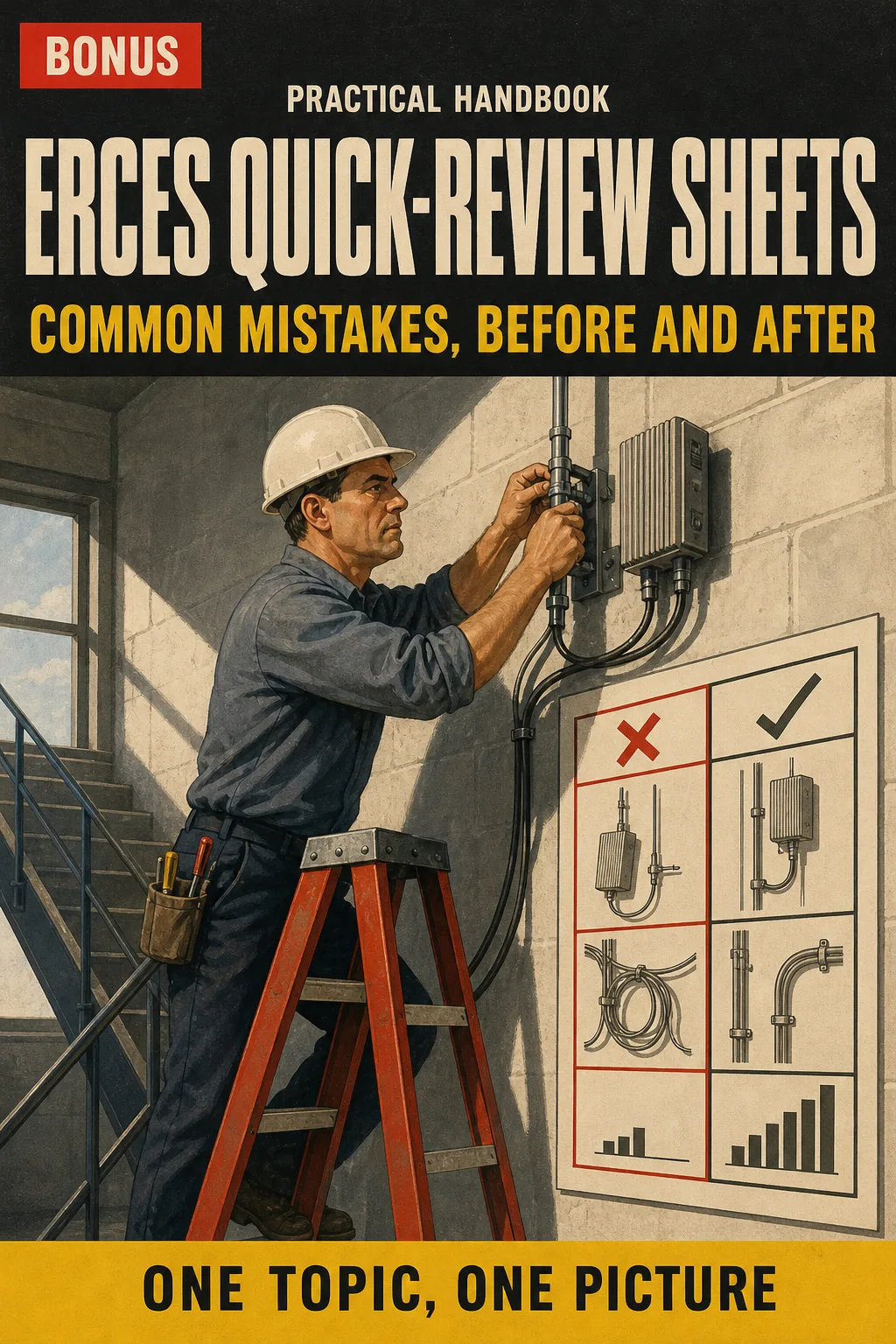
ERCES Quick-Review Sheets: Common Mistakes, Before and After

BONUS 2: «ERCES Quick-Review Sheets: Common Mistakes, Before and After»

Value on its own: US$ 14.90

Review the night before your exam or walk test: the most common install and test mistakes, each one drawn wrong and then right, on one page.

ERCES Public Safety Radio Illustrated with 2 Free Books

  • ERCES Public Safety Radio Illustrated: 64 illustrated pagesUS$ 63
  • BONUS 1: ERCES Practice Book: Exam-Style Questions with Worked AnswersUS$ 17.90
  • BONUS 2: ERCES Quick-Review Sheets: Common Mistakes, Before and AfterUS$ 14.90
  • High-resolution PDF to printIncluded
Total value US$ 95.80
YOUR PRICE:
US$ 27
You save US$ 68.80
YES, I WANT ERCES PUBLIC SAFETY RADIO ILLUSTRATED FOR US$ 27

📄 This is a digital PDF book sent to your email: nothing is printed or shipped.

Secure purchaseEncrypted payment30-day guarantee

PDF by email: We email you ERCES Public Safety Radio Illustrated as a PDF, together with the two free books. It's a single payment: no installments, no extra charges.

Who This Book Is For

You're starting on ERCES

You're starting on ERCES

You get the whole system as one drawing, from the roof to the stairwell, and every piece in its own page after that.

Your NICET exam is coming up

Your NICET exam is coming up

The dB math in the same 4 steps every time, the numbers to know cold on one page and practice questions to check yourself.

You already install BDA systems

You already install BDA systems

A page to pull up before the walk test: the grid, the failure rule, the procedure and what the inspector will check.

Everything You Get Today

US$ 95.80US$ 27
YES, I WANT ERCES PUBLIC SAFETY RADIO ILLUSTRATED FOR US$ 27

📄 This is a digital PDF book sent to your email: nothing is printed or shipped.

30DAYS
GUARANTEE

30-Day Guarantee

Try ERCES Public Safety Radio Illustrated for 30 days, bonus books included.

We refund everything if the file won't open, if the book isn't what you see here, if you were charged twice or if the email doesn't arrive. Just email us.

You pay once. No subscriptions.

Frequently Asked Questions

Is it for me if I've done fire alarm or low-voltage work for years but never studied RF?

Yes. It starts from what you already install and draws the radio side, with the dB math in 4 steps. It's not an engineering text, and it's not a beginner's pamphlet either.

Where does the content come from?

From IFC Section 510 (2024 edition), NFPA 1225 Chapter 18, NFPA 72 pathway survivability, FCC 47 CFR 90.219 and NEC Articles 810/820, cross-checked against the published NICET IB-PSC Level I content outline. Your city may run an older IFC or local amendments, so every value carries its code section: you check it against the edition your AHJ adopted.

Is it official material?

No. It's an independent study book. It's not published or endorsed by NICET, NFPA, ICC or the FCC, and it's not affiliated with them. It doesn't give you a certification or CEUs: the NICET certification comes only from passing the NICET exam.

Does it replace a course or training?

No. It's a study and review companion. It doesn't replace your training, the manufacturer's instructions, the adopted code or what your AHJ requires.

Are the practice questions the ones on the exam?

No. They're written for this book, on the topics of the content outline. They are not official exam questions.

When and how do I get it?

The book and the 2 bonus books come as PDFs by email, to the address you enter at checkout.

Do I have to pay every month?

No. It's a one-time payment, with no subscription.

Can I have it on paper?

It's a PDF you can print at home or at a print shop: the whole book or just the pages you want on the job site.

How does the refund work?

You have 30 days. We refund everything if the file won't open, if the book isn't what you see on this page, if you were charged twice or if the email doesn't arrive: just email us.

Before You Close This Page

No more rereading the code and retaining nothing.

The signal path from donor antenna to stairwell: you see it drawn, start to finish.

You walk into the exam and the walk test knowing where everything is.

Drawings make studying faster.

The book is right below.

One-time payment: US$ 27 · Guarantee: 30 days · PDF by email

YES, I WANT ERCES PUBLIC SAFETY RADIO ILLUSTRATED FOR US$ 27

📄 This is a digital PDF book sent to your email: nothing is printed or shipped.